

Can a rotary evaporator be used for removing water from a sample? That's a question I get asked a lot as a supplier of rotary evaporators. And the answer is a resounding yes! In this blog post, I'm gonna break down how rotary evaporators work, why they're great for removing water from samples, and give you some tips on using them effectively.
First off, let's talk about what a rotary evaporator is. It's a piece of lab equipment that's used to remove solvents from samples through evaporation. The basic setup consists of a round-bottom flask where the sample is placed, a heating bath to heat the sample, a condenser to cool and condense the evaporated solvent, and a vacuum system to reduce the pressure inside the system. When you spin the flask (hence the "rotary" part), it increases the surface area of the sample, which speeds up the evaporation process.
Now, when it comes to removing water from a sample, rotary evaporators are super useful. Water has a relatively high boiling point (100°C at standard atmospheric pressure), but by using a vacuum system, we can lower the boiling point of water significantly. This means we can evaporate the water at a much lower temperature, which is great for samples that might be sensitive to high heat. For example, if you're working with biological samples or heat - labile compounds, you don't want to subject them to high temperatures for too long. A rotary evaporator allows you to gently remove the water without damaging your sample.
Another advantage of using a rotary evaporator for water removal is its efficiency. The spinning action of the flask and the large surface area it creates mean that water can evaporate much faster compared to other methods. Plus, with the condenser, you can collect the evaporated water, which is useful if you need to analyze it later or if you want to reuse it in some cases.
Let's take a look at some practical aspects of using a rotary evaporator for water removal. First, you need to choose the right setup. The size of the round - bottom flask depends on the volume of your sample. If you have a large sample, you'll need a bigger flask. Also, you need to set the right temperature for the heating bath. As I mentioned earlier, with the vacuum, you can lower the boiling point of water, so you don't need to set the bath at 100°C. Usually, temperatures between 30 - 60°C are sufficient in most cases when using a good vacuum system.
The vacuum level is also crucial. A better vacuum will lower the boiling point of water more, allowing for faster evaporation. Make sure your vacuum pump is working properly and that there are no leaks in the system. You can use a vacuum gauge to monitor the vacuum level.
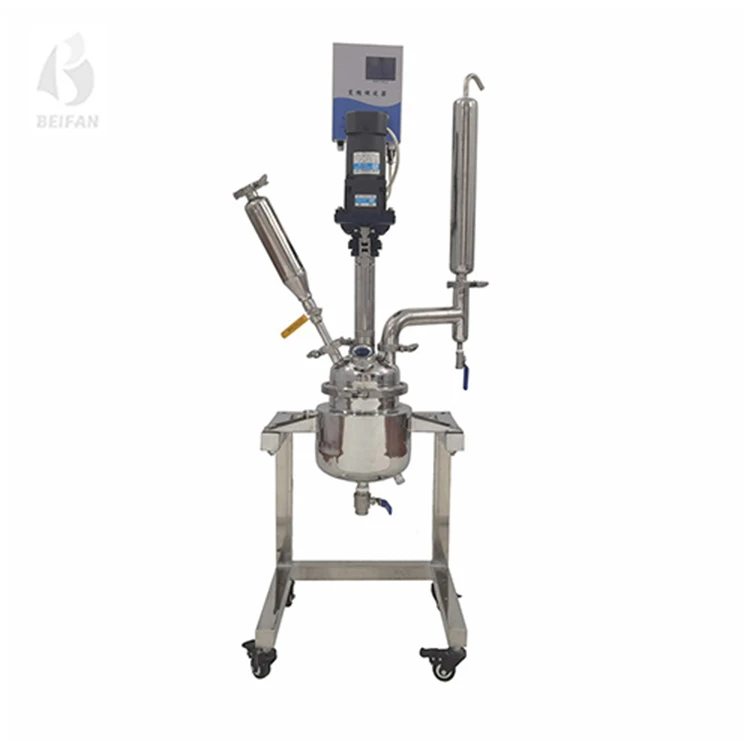
Now, I'd like to mention some of the other equipment that can work well with a rotary evaporator when removing water from samples. For example, the 2L Double - layer Stainless Steel Reactor can be used to prepare the sample before putting it into the rotary evaporator. It's great for mixing and reacting different components in a controlled environment.
The 10L High Temperature Oil Bath can be a great addition if you need more precise temperature control. Oil baths can heat up more evenly and can reach higher temperatures if needed, although as I said, you usually don't need extremely high temperatures for water removal.
And the 5L Single Layer Glass Reactor can be used for small - scale sample preparation or for running reactions that are related to the sample you're going to process in the rotary evaporator.
Of course, like any piece of equipment, there are some things to watch out for when using a rotary evaporator for water removal. One common issue is bumping. Bumping occurs when the liquid in the flask boils too violently and splashes up into the condenser. To prevent this, you can add some anti - bumping granules to the flask. These granules provide nucleation sites for the bubbles to form, which helps the liquid boil more smoothly.

Another thing is the cleanliness of the equipment. Make sure the flask, condenser, and other parts are clean before use. Any contaminants can affect the quality of your sample and the performance of the rotary evaporator.
In conclusion, a rotary evaporator is an excellent tool for removing water from a sample. It offers a gentle, efficient, and controllable way to get rid of water, especially for heat - sensitive samples. Whether you're in a research lab, a pharmaceutical company, or an educational institution, a rotary evaporator can be a valuable addition to your equipment collection.
If you're interested in purchasing a rotary evaporator or any of the related equipment I mentioned, I'd love to talk to you. We have a wide range of high - quality products that can meet your specific needs. Don't hesitate to reach out and start a conversation about your requirements. We can work together to find the best solution for your water - removal and sample - processing needs.
References
- "Laboratory Techniques in Organic Chemistry" by Donald L. Pavia, Gary M. Lampman, George S. Kriz, and Randall G. Engel
- "Practical Organic Chemistry" by A. I. Vogel


